
 The basic philosophy underlying India’s relations with Britain was laid down, unsurprisingly, by Mahatma Gandhi.
Gandhi hated British rule and admired the British people. He praised their character and patriotism; and reminded anyone who would listen that the British were indomitable in a crisis.
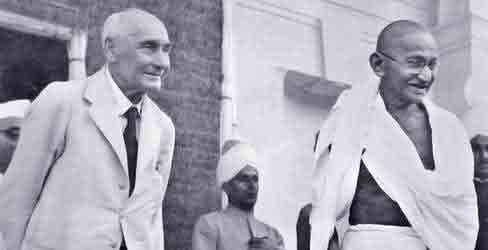
His close friends included Rev. Charlie Andrews, acclaimed in his adopted land as “Deshbandhu” [Friend of India]; the reformer Agatha Harrison; and a former Viceroy Lord Irwin. When Irwin lost his son in the war, Gandhi told Indians that they should emulate such exemplary selfless patriotism.
The Mahatma’s magnetic appeal, in turn, charmed the East Enders of London, with whom he stayed on his only visit to Britain during the freedom struggle, in 1931, for the Second Round Table Conference. They even welcomed the goat commandeered to provide milk for Mahatma’s frugal diet. Gandhi was welcomed as a hero by the workers of Lancashire despite the unsubtle propaganda that his crusade against British goods had led to loss of jobs in Lancashire’s cotton mills. East End children, who cheerily followed the man in a loincloth when he went for a walk, gave Gandhi toys as a present when he left for India in December, which he kept as a precious memory.
Never any rancour
Gandhi understood and emphasised the difference between British rule and the British people. This was the basis for India’s warm relationship with Britain after independence. Despite the many deep and debilitating wounds of colonialism, there was never any rancour. The bitter past was left in the folds of history.
It is not widely known that Gandhi proclaimed he had an “English heart” when World War broke out in September 1939. An emotional Mahatma, speaking in specific words from an “English heart”, wanted India to give unequivocal support to the British in the war against Hitler’s evil. On September 4, 1939 Gandhi told the Viceroy, the Scotsman Victor Hope, 2nd Marquess of Linlithgow: “…my own sympathies were with England and France from the purely humanitarian standpoint.
I told him I could not contemplate without being stirred to the very depth the destruction of London which had hitherto been regarded as impregnable. And as I was picturing before him the Houses of Parliament and the Westminster Abbey and their possible destruction, I broke down.”
Hitler called insane
The Mahatma, who had studied law in London, was in tears at the thought that Parliament and Westminster Abbey might be destroyed by Hitler’s bombs. Gandhi described Hitler as insane and abhorrent beyond measure. When appeasement was still considered a viable option in London, Gandhi castigated Hitler for the murderous Nazi campaign against Jews that became a holocaust. Of course, his advocacy of non-violence could lead him to some naïve prescriptions, but his analysis of evil was profound and often far ahead of contemporary vision.
Hitler, in turn, advised the British to kill Gandhi and end their biggest problem. Hitler told Lord Irwin in November 1937: “All you have to do is shoot Gandhi. You will be surprised how quickly the trouble will die down”. London ignored such malicious advice. The British were imperialists, not fascists.
Rejection by Cong Gandhi’s proposal of support for the British was rejected – not by London, but by the Congress. This was the first time that the party he nurtured into a colossus had rejected Gandhi’s suggestion. Perhaps no one fully understood how good this decision would be in the long term Indian interest. The Congress Working Committee had the audacity to send a letter warning Gandhi against striking a deal with Linlithgow over the war at their meeting on 4 September. A rueful Mahatma said later: “I have returned from the Viceregal Lodge empty-handed and without any understanding, open or secret.”
[These details are available in Volume 76 of the Collected Works of Mahatma Gandhi.] Gandhi felt he had no option except to bow before the disciples he had spawned.
Nehru drafted the Congress resolution demanding freedom as the immediate price of support, despite Gandhi’s doubts. While this game-changing episode is detailed in my next book, ‘Gandhi: A Life in Three Campaigns’, this should be the theme of a scholar’s doctoral thesis for the consequences were immense. If Congress had accepted Gandhi’s proposition in 1939, there would never have been partition in 1947. Partition, a scalpel cut across India’s heart, has stained generations in blood.
Good intentions aplenty
Despite the popular goodwill, visible in London as a tourist destination and Oxbridge as an academic aspiration, Delhi and London have never reaped the true dividend of a partnership. Britain, weakened by war and loss of empire, found succour in a special strategic relationship with America and a more arduous socio-economic bridge with Europe. India and Britain had plenty of good intentions, but good intentions are often not good enough.
The former American Secretary of State Dean Rusk tellingly described the British plight in the 20th century: Britain had lost an empire but not found a role in the world. This century is different. India is at last punching above its expected weight under the leadership of Prime Minister Narendra Modi. Together, with realistic, carefully delineated objectives, India and Britain can become a force multiplier in trade and investment. As bastions of democracy, they can help mobilise the forces of freedom across the world; and as principal members of the Commonwealth, they can convert a talking shop into a workshop. These are pragmatic and achievable goals which Prime Ministers Modi and Rishi Sunak can structure as defining markers on a shared horizon.