
 ON August 31, 2023, when the Opposition under the banner of the coalition named I.N.D.I.A. was assembling in Mumbai to plan out its future course of action and while some others were celebrating belated Raksha Bandhan, the Union Government announced a special session of Parliament from September 18 to 22, shortly after the conclusion of G20 Summit in New Delhi.
The Minister for Parliamentary affairs stated that the special session would have five sittings and amid Amrit Kaal (the quarter century leading up to 100 years of independence) the Government was looking forward to having fruitful discussions and debate.
Summoning the Parliament for a special session is not a singularity. It is unusual, but not unconstitutional. Article 85 of the Constitution of India states that the President shall from time to time summon each House of Parliament to meet at such time and place as he/she thinks fit, but six months shall not intervene between its last sitting in one session and the date appointed for its first sitting in the next session.
As the monsoon session has just concluded the requirement relating to not more than six months’ gap is not at all a concern. Moreover, the Constitution nowhere prescribes the convening of the Parliament on only three occasions during a year, namely the budget session, the monsoon session and the winter session.
Article 352 of the Constitution refers to a ‘special sitting’ of the Lok Sabha in the context of proclamation of emergency, which is not relevant here.
Past special sessions
Special sessions in the past have been held with proper debates and discussions as well as to celebrate certain historical events. In 1962 a special session was called on November 8-9 at the instance of late Atal Behari Vajpayee to discuss the Indo-China war situation.
A special session was also held on November 26-27, 2015 to pay tributes to Dr. BR Ambedkar on his 125 birth anniversary. The two-day special sittings in the Lok Sabha and the Rajya Sabha were part of year-long celebrations to honour the architect of the Indian Constitution. The theme was to discuss the polity’s commitment to the Constitution The same year, the Government of India declared November 26 as the Constitution Day to raise awareness on Dr. Ambedkar’s thoughts as part of his birth anniversary celebrations.
A six-day special session was held from August 26 to September 1, 1997 to commemorate the 50th anniversary of India’s independence. A joint parliamentary sitting of the Lok Sabha and the Rajya Sabha was held on June 30, 2017 to mark the rollout of Goods and Services Tax (GST) Act with effect from July 1, 2017.
The first celebratory session was held on August 14-15, 1947 on the eve of India’s independence. Celebratory sessions were also held on August 9, 1992 to mark the 50th anniversary of Quit India movement and on the midnight of August 14-15, 1972 to celebrate the silver jubilee of India’s independence.
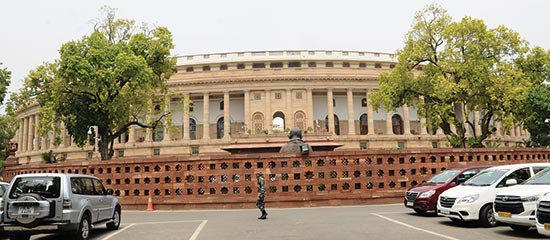
New Parliament building The current special session comes closest to the six day special session held in 1997 to commemorate the 50th anniversary of India’s independence. The present session may inter alia mark the functioning of the new Parliament building during the auspicious Ganeshotsav and in close proximity to Mr Modi’s birthday, in the presence of the parliamentarians of G20 countries (P20).
As regards the agenda for the special session, the Minister for Parliamentary affairs is reported to have said that it will be shared shortly. The announcement of the special session has no doubt put a spanner in the works of the Opposition while it met to firm up its strategy on various issues leading up to the next Lok Sabha elections due in 2024.
Speculations are rife that the Government may try to push through some momentous, yet contentious, legislation such as reservation for women in Parliament.
But, with the announcement of a panel under former President Ramnath Kovind to explore the feasibility of ‘One Nation One Election’, the legislative process to put it into practice has become the front-runner. However, it is easier said than done. The matter has been considered, from time to time, since 1983.
In 2018, a draft report of the Law Commission had recommended three options for synchronising the elections in the country, beginning with the Lok Sabha Election 2019.
Besides many pros and cons of the concept, a large number of amendments to the laws, rules and regulations would need to be carried out, making the task very arduous, if not impossible, and open to challenge in the courts on ground of defilement of the doctrine of basic structure.
Statute amendments
Amendments to the Constitution would encompass Articles 83 (Duration of Houses), 85 (Dissolution of the Lok Sabha), 172 (Duration of State Legislatures), 174 (Dissolution of State Legislatures), 356 (Failure of Constitutional Machinery) and the Tenth Schedule (to ensure that all disqualification issues arising from defection are decided by the presiding officer within six months). Ratification of the amendments by not less than one-half of the state legislatures may also be required to be taken as a matter of abundant precaution.
Amendments to laws would inter alia require changes in the Representation of People Act, 1951, such as Section 2 (adding a definition of ‘simultaneous elections’), and Section 14 and 15 (Notification of General and State Assembly Elections). The Rules of Procedure and Conduct of Business of the Lok Sabha and the State Legislative Assemblies would need to be amended to replace ‘Motion of No-Confidence’ with ‘Motion of Constructive Vote of No-Confidence’.
Political consensus
Perhaps the biggest hurdle would be creation of political consensus for simultaneous elections requiring some states governments to agree to curtail terms of their Legislative Assemblies and forego their regional identities.
What is in the realm of possibility though is announcing the next parliamentary elections to coincide with the forthcoming Assembly elections to state Assemblies of Madhya Pradesh, Chhattisgarh, Rajasthan, Telangana et al. The Union Government may also attempt to cajole some of the states where elections are due in 2024, such as Maharashtra, to join in. This may mark a small step to move towards the grand vision of ‘One Nation One Election’.
Internationally, some of the countries which have ‘One Nation One Election’ system include Belgium, France, Germany, Hungary, Indonesia, Poland, South Africa, Spain and the United Kingdom among others.
What exactly is going to happen during the short five-day special session amid Amrit Kaal, only the time will tell. Till then, please hold your breath.